By Poppa Ben | PoppaBen.com
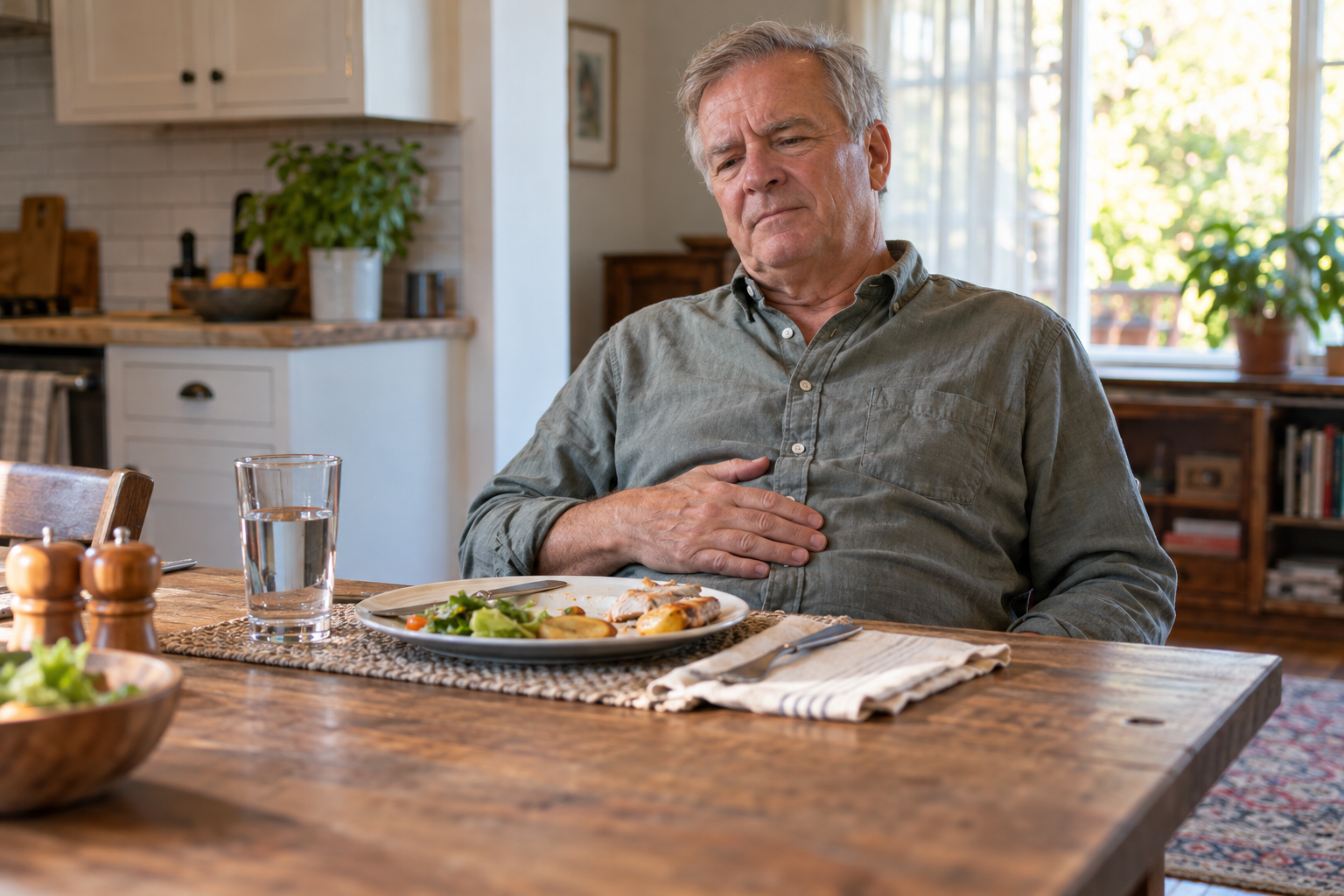
You finish a good meal, lean back in your chair, and there it is. The waistband feels tight. Your belly feels like a balloon somebody kept pumping. And you start the guessing game: was it the bread? The beans? That second helping?
Friend, you’re in good company. Bloating is one of the most common tummy complaints around. The good news is that occasional bloating often gets better with a few simple changes, and most of them don’t cost a dime.
Let’s walk through it together. What’s going on in there, what you can try at home, and when it’s time to let a doctor take a look.
First Things First: Bloated Isn’t Always “Gassy”
Here’s something most people don’t know. Bloating is the feeling of pressure or fullness. Distention is when your belly actually looks bigger. You can have one without the other. [1,2]
So where does the gas come from? Two places. Some of it is air you swallow. The rest is made by the bacteria in your gut as they break down food, especially certain carbohydrates. [1]
But here’s the twist. Plenty of bloated folks don’t have any more gas than the next person. Their gut is just more sensitive to it, or things are moving through a little slowly. IBS, constipation, and food intolerances can all play a part. [2]
So instead of asking “What’s making all this gas?” try asking “What’s my body’s pattern?”
Slow Down, Sit Down, Chew
Let’s start with the free stuff. Eating in a hurry, talking while you chew, sipping through a straw, chewing gum, and drinking fizzy drinks all add swallowed air. [3]
Try this for a week:
● Sit down to eat, and give yourself a few minutes away from the rush.
● Take smaller bites and put your fork down between them.
● Swap soda or sparkling water for plain water.
● If big meals leave you stuffed, eat a little less at a time and spread your food out over the day.
There’s an old saying: “Your stomach doesn’t have teeth.” Chewing well is part of digestion, and it’s free.
Yes, Even Healthy Food Can Do It
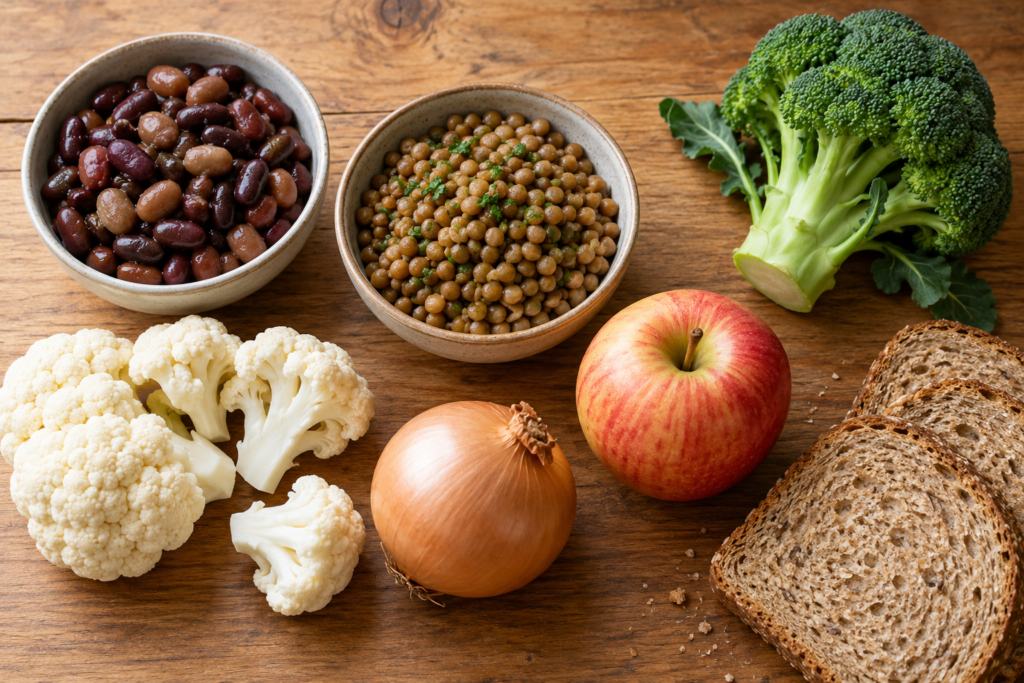
Beans, lentils, broccoli, cabbage, cauliflower, onions, some fruits, and whole grains are wonderful foods. They can also make gas in some people. [4] That doesn’t mean you have to give them up. Often a smaller portion or a different way of cooking makes all the difference.
A few things to try:
● Start with smaller servings and work your way up.
● If you cook dried beans, soak them first, pour off the soaking water, and cook them well in fresh water.
● Try cooked vegetables instead of a big pile of raw ones, and see which sits better.
● Notice whether it’s one food, or one big meal piled with several possible troublemakers at once.
Keep a simple food diary. Jot down what you ate, how much, how you felt afterward, and how your bowels are doing. Change one thing at a time. After two or three weeks, patterns often start to show up. And if they don’t, that diary is still a big help when you talk to a health professional. [4]
Watch Out for “Sugar-Free”
Sugar-free gum, mints, candy, and protein bars often contain sugar alcohols like sorbitol, mannitol, xylitol, and maltitol. Your body doesn’t fully absorb them, and they can cause gas, bloating, or loose stools, especially if you have a lot. [4]
If your bloating started around the same time as a new “diet” product, check the label.
Could It Be the Dairy?
If milk or ice cream keeps giving you trouble, lactose could be the reason. Lactose is the natural sugar in milk, and many adults don’t make enough of the enzyme that digests it. Bloating, gas, and loose stools are common results. [1,3]
The good news is you probably don’t have to give up dairy completely. Lots of people do fine with smaller portions, hard cheeses, yogurt, lactose-free milk, or a lactase enzyme taken with dairy. It’s a matter of finding what works for you. [3]
Don’t Forget Your Bowels
This one gets overlooked all the time. If you’re bloated and backed up, constipation may be part of the problem, and taking care of it can help your belly feel better. [2]
If you’re straining, passing hard stools, or feeling like you never quite finish, mention it to your health professional. Fiber, fluids, and movement can help. Just go easy on the fiber. Too much, too fast, can actually make gas worse. [2,4]
The After-Dinner Stroll
Our grandparents had the right idea with the evening walk.
In a 2021 study, 94 adults with ongoing bloating were split into two groups for four weeks. One group took common digestive medicines. The other group took a slow 10–15 minute walk after each meal. Both groups improved, and for that heavy, full feeling after eating, the walkers actually did better. [11] It was one small study, so it’s not the final word, but it’s a nice result for something this easy.
The people in the study walked slowly, with their hands clasped behind their back and their chin tipped down a little. You can try that if you like, but a plain, easy walk is a fine place to start.
Can’t get outside? Walk the hallway, the living room, or the driveway. Keep it gentle, and save the hard workouts for when your stomach has settled.

Kitchen Helpers: Ginger, Peppermint, and Fennel
Nature’s medicine cabinet has a few old friends for the tummy. I want to be straight with you about what the science says, though.
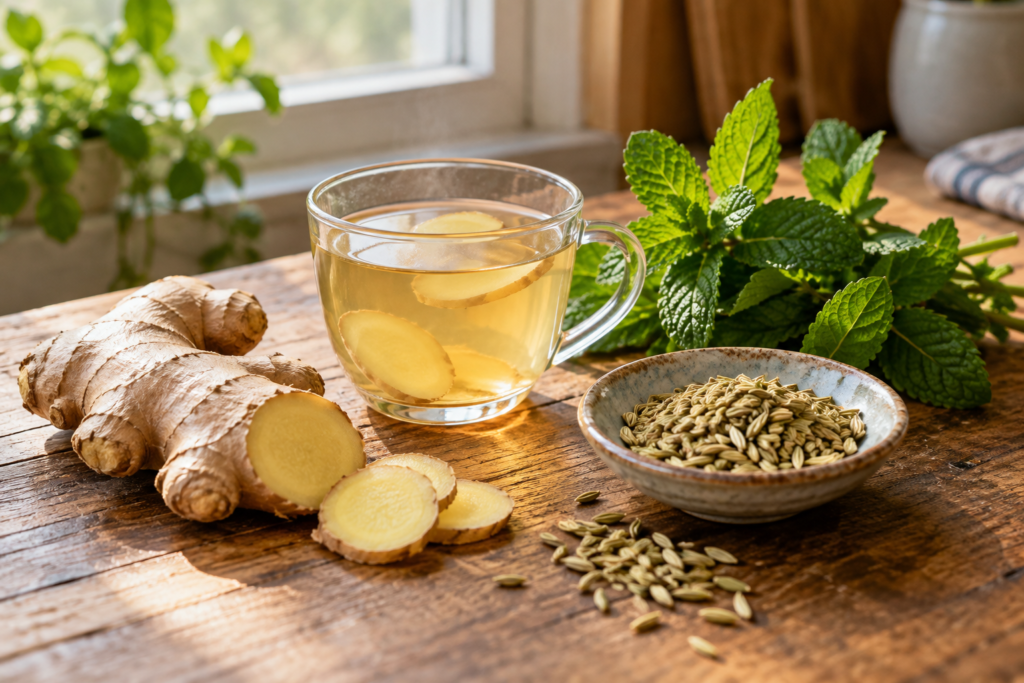
Peppermint. Peppermint oil has some evidence behind it for overall IBS symptoms, and the American College of Gastroenterology suggests it, though they call the evidence low quality. [12] That research was done on peppermint oil capsules, not peppermint tea. Enteric-coated capsules are designed to open past the stomach, but they can still cause heartburn. If you have reflux, peppermint may make it worse.
Ginger. People have used ginger for indigestion for centuries. In one small study of 11 people, ginger capsules helped the stomach empty faster, but the people didn’t actually feel much different. [13] A few slices of fresh ginger in hot water make a lovely after-meal drink. Just think of it as a comfort, not a cure.
Fennel. In many cultures, people chew a pinch of fennel seeds after a meal. You’ll often see a little bowl of them by the door in Indian restaurants. It’s a lovely old tradition, but there isn’t good evidence yet that it treats bloating.
If you take prescription medicines, check with your pharmacist before starting any herbal supplement. Concentrated extracts are stronger than a cup of tea, and even teas can sometimes cause side effects.
What About Low Stomach Acid?
We usually hear about too much stomach acid. But some people make too little. It’s called hypochlorhydria. Stomach acid helps get protein digestion going and helps you absorb iron and vitamin B12 from food. When it runs low, some people feel full, bloated, or uncomfortable after meals. [7]
Here’s the catch: bloating alone doesn’t prove you have low acid. Plenty of other things cause the same feelings. So please don’t start betaine HCl or other acid supplements on your own, especially if you have reflux, gastritis, or ulcers. And never stop a prescribed acid-reducing medicine without talking to your doctor first. [7] This is one to figure out with a professional.
Your Gut Garden
Your gut is home to trillions of tiny microbes. I like to think of it as a garden. When that garden gets thrown off balance, it’s sometimes called dysbiosis. But it’s a lot more complicated than “good bugs versus bad bugs.” [8,10]
Antibiotics can stir up the garden. So can stress, illness, changes in diet, and how fast or slow food moves through you. Constipation and gut bacteria affect each other, too, in both directions. [9,10]
There’s no single “perfect” gut that everybody should have. And bloating alone can’t tell you whether your gut bacteria are off, or which ones are involved. That’s why one probiotic isn’t the answer for everyone. [5,8,10]
In my own work with people, I’ve noticed that some still feel bloated even when they’re fasting for health reasons, including intermittent fasting. An empty stomach doesn’t always mean a comfortable belly. Dysbiosis may be one possible contributor, but bloating during fasting alone doesn’t prove that. Constipation and other digestive issues can also play a part.
Stress and the Belly
Your gut and your brain talk to each other all day long. When you’re stressed, your belly often feels it first. That doesn’t mean the bloating is “all in your head.” The discomfort is real. But calming your nervous system can help settle your stomach, too. [2]
Take a few slow breaths before you eat, find a quieter moment when you can, and take time to actually enjoy your food.
The Low-FODMAP Option
For some people with IBS, a short trial of a low-FODMAP diet can bring relief. FODMAPs are certain carbohydrates that some people’s guts have a hard time with. [4,5]
This isn’t meant to be a forever diet. You cut back for a few weeks, then add foods back one at a time to find your personal triggers. It works best with a dietitian guiding you, so you don’t end up eating fewer and fewer foods. [5]
Probiotics and Enzymes: Match the Fix to the Cause
Sometimes a supplement helps, but only when it fits the problem. Someone who’s lactose intolerant, for example, may do well with a lactase enzyme when eating dairy. [3]
Probiotics are trickier. The American Gastroenterological Association actually advises against using probiotics specifically to treat bloating. [5] They may still have a place in other situations, so talk it over with someone who knows your history.
Sometimes the particular probiotic strain makes a difference, and a health professional may recommend a specific one for a specific reason. That doesn’t mean everyone with bloating needs one. I’ve also heard personal reports of people whose egg allergy reportedly improved while taking L. reuteri. Oxiceutics is the company that has the research on the benefits of this probiotic. Those stories don’t establish that the probiotic caused the improvement or that it treats egg allergy. If you have a diagnosed egg allergy, keep following your allergy plan and don’t try eating eggs again without your allergist’s guidance.
And one more thing: bloating by itself doesn’t mean you have SIBO (small intestinal bacterial overgrowth). Testing only makes sense for certain people, depending on their symptoms and medical history. [5]
When to Call the Doctor
Occasional bloating is usually something you can manage at home. But please make an appointment if your bloating won’t go away, keeps coming back, or is getting worse, or if it comes with any of these:
● Weight loss you can’t explain
● Blood in your stool
● Vomiting
● A lasting change in your bowel habits
● New symptoms that start after age 50 [2]
Get help right away for sudden, severe belly pain, or a swollen belly with vomiting when you can’t pass gas or stool. [6]
Poppa Ben’s Bottom Line
You don’t have to fix everything at once. Pick one small change this week and see what happens. Your body is always giving you clues, and keeping track helps you read them.
Your starter checklist:
● ☐ Sit down and eat slowly
● ☐ Swap fizzy drinks for plain water
● ☐ Check labels for sugar alcohols
● ☐ Take an easy 10–15 minute walk after meals
● ☐ Pay attention to constipation, and ask for help if you need it
● ☐ Keep a simple food and symptom diary for 2–3 weeks
You deserve to enjoy your food and feel good afterward. If simple changes don’t do the trick, bring your diary to a health professional. It’ll give them a head start on finding the answer. To feel good, your gut needs to also feel good. It may solve a lot of the problem. However, if the problem is emotionally rooted, you may need to do other things to destress. See my posts on energy work and getting back to nature.
This article is for general education only and isn’t a substitute for personal medical advice.
Sources
1. NIDDK: Symptoms and Causes of Gas
2. AGA: Belching, Bloating, and Abdominal Distention
3. NIDDK: Treatment for Gas
4. NIDDK: Eating, Diet, and Nutrition for Gas
5. AGA Clinical Practice Update: Evaluation and Management of Belching, Abdominal Bloating, and Distention
6. NHS: Bloating
7. Cleveland Clinic: Hypochlorhydria (Low Stomach Acid)
8. NIH Office of Dietary Supplements: Probiotics
9. Procházková et al.: Advancing Human Gut Microbiota Research by Considering Gut Transit Time
10. ISAPP Consensus Statement on the Definition and Scope of Gut Health
12. American College of Gastroenterology IBS Treatment Guide: Peppermint Oil
13. Hu et al.: Effect of Ginger on Gastric Motility and Symptoms of Functional Dyspepsia (2011)

Ben — known to his clients and readers as Poppa Ben — is a certified practitioner of Natural Bioenergetics (formerly Health Kinesiology) with decades of hands-on experience helping people restore their energy and vitality. He writes about natural health, nutrition, herbs, energy work, and the occasional skin-healthy recipe. His approach always comes with the same reminder: your body wants to be in balance, and sometimes it just needs someone to listen.